Tristan Perich: Open Symmetry
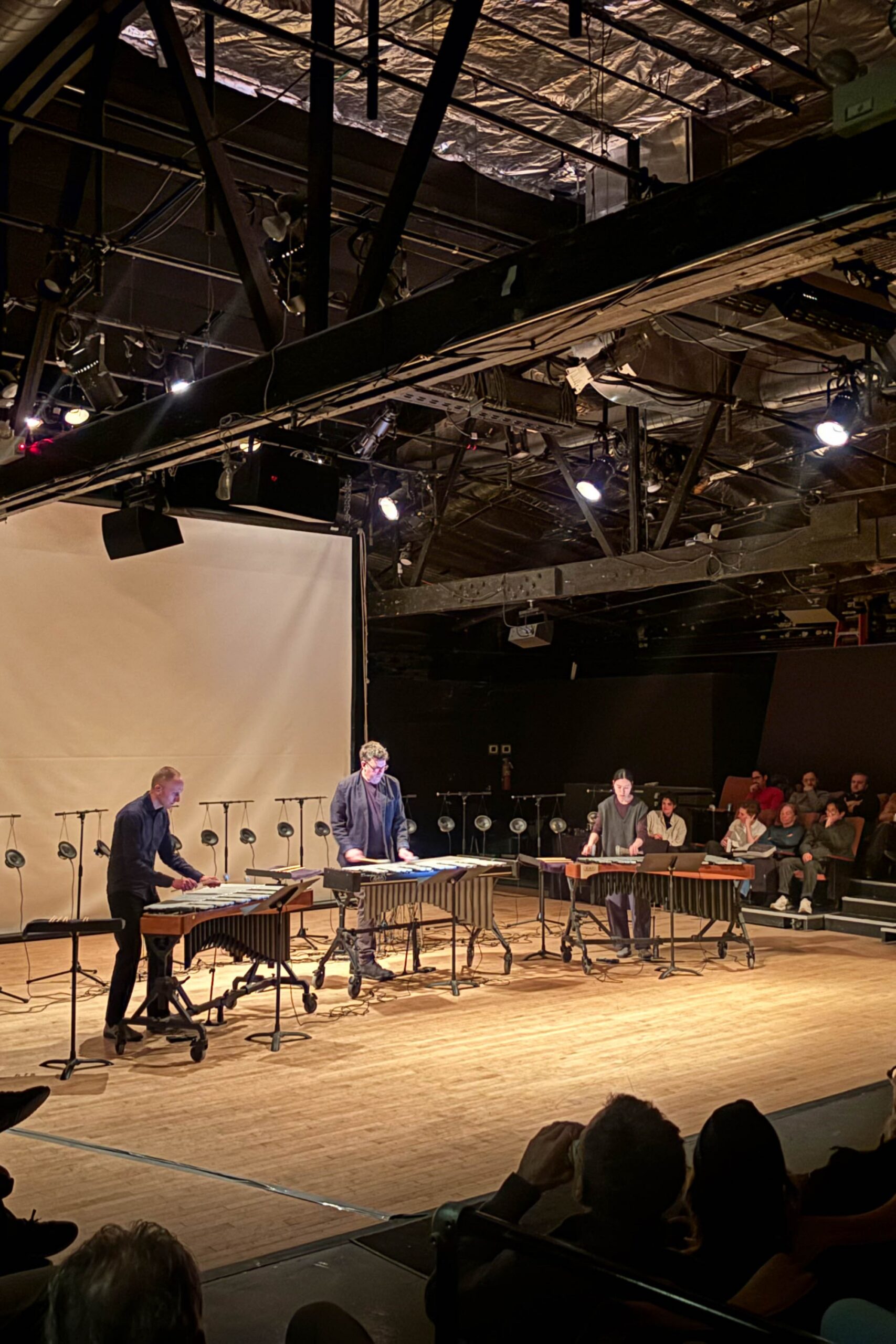
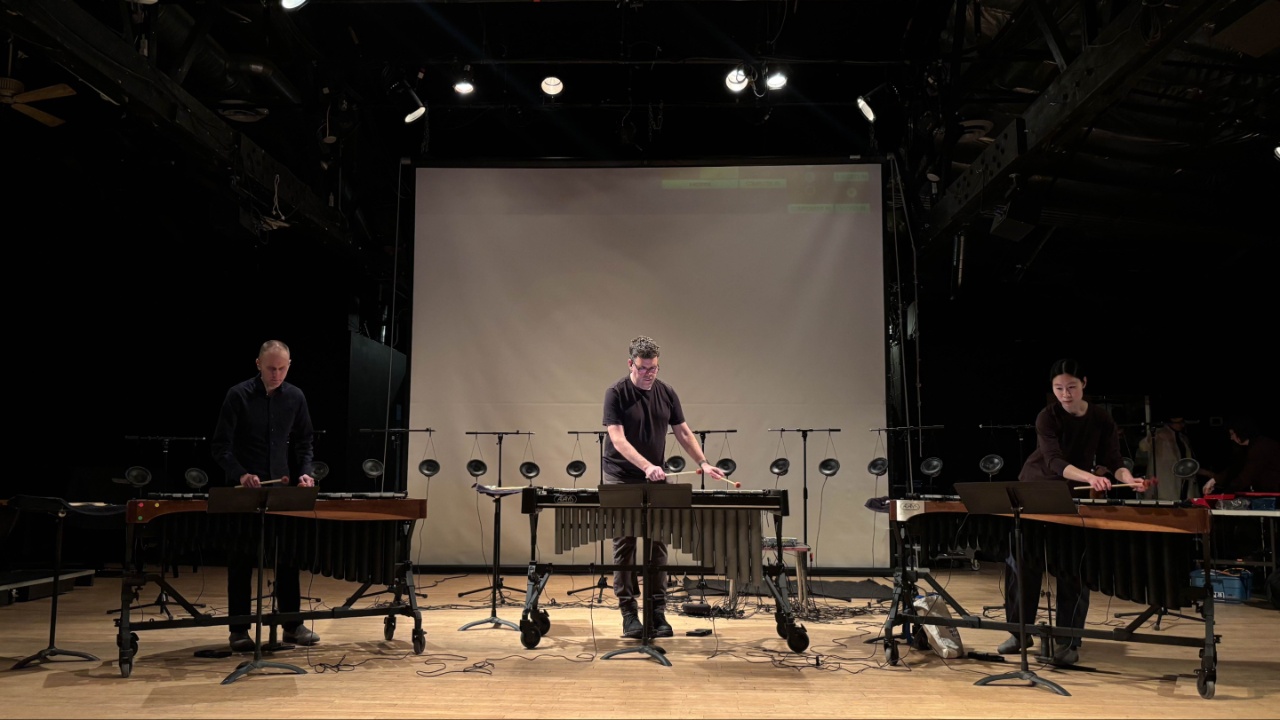
Performers at Big Ears:
Tristan Perich, composer
Doug Perkins,vibraphone
Ian Antonia, vibraphone
Xin Yi Chong, vibaphone
Open Symmetry was born out of an artistic connection between Perich and ensemble 0, in particular one of its members, Stéphane Garin, whom Perich first met in New York in 2014 when Garin was touring with Ryoji Ikeda. Garin was already playing Perich’s music live, but it was at this point that he decided to commission a piece by him, which eventually became Open Symmetry. From their first conversations, they knew it would be a large project, which Perich ultimately scored for 3 vibraphones and his 1-bit electronics. ensemble 0 premiered the piece in 2019 at Le Lieu Unique’s Variations Festival in Nantes, and after touring it for a few years, they recorded it for an album release.
If Perich’s project with 50 violins was about blurring and blending, Open Symmetry is about precision and energy. Vibraphones, typically played with percussion mallets, have a sharp attack and a long, clean resonance, which can be controlled by foot pedal. The opening section of the recording is a rapid and stereophonic hocket of a single pitch passed between the three percussionists of ensemble 0: Stéphane Garin, Julien Garin, and Alexandre Babel. Perich gradually introduces the elements of the musical composition, later bringing in electronic tones, then slowly adding extra pitches until the musical contours start shifting, marking the arrival of Section 2. As the musical fragments get longer, harmonies emerge and overlap, washing over like soothing waves.
The vibraphone interests Perich due to its purity of sound, which blends seamlessly with the 1-bit tones. As the piece progresses and becomes more complex, the layers of 1-bit electronic sound and percussion become less distinctive, getting lost in a beautiful accumulative effect. This comes into focus in Section 3, a jubilant moment in the piece where percussion and electronics become indistinguishable and the listener is awash in tone.
Tristan Perich’s (New York) work is inspired by the aesthetic simplicity of math, physics and code. The WIRE Magazine describes his compositions as “an austere meeting of electronic and organic.” 1-Bit Music, his 2004 release, was the first album ever released as a microchip, programmed to synthesize his electronic composition live. His follow-up circuit album, 1-Bit Symphony, has received critical acclaim, called “sublime” (New York Press), and the Wall Street Journal said, “its oscillations have an intense, hypnotic force and a surprising emotional depth.” The New York Times called his latest circuit album, Noise Patterns, “techno for silicon-based life forms.†As an electronic musician, he has performed internationally, from Sonár, MUTEK and the Barbican to Lampo and The Kitchen. As a composer, he has received commissions from So Percussion, the LA Philharmonic, Calder Quartet and more, as well as an award of distinction from Ars Electronica for his work for violins and 1-bit electronics, Active Field. The New York Classical Review wrote, “More than any composer of his generation, Perich is establishing a new language and a new future path for music.†As a visual artist, his audio installations, video works and machine drawings have received commissions from the likes of Rhizome and L’Auditori in Barcelona, and his artwork has been exhibited internationally, including the Museum of Modern Art, VOLT Festival, the San Diego Museum, the Georgia Museum, and bitforms gallery.